

 0.00
0.00
 0
0


19751 Views | October 26, 2024
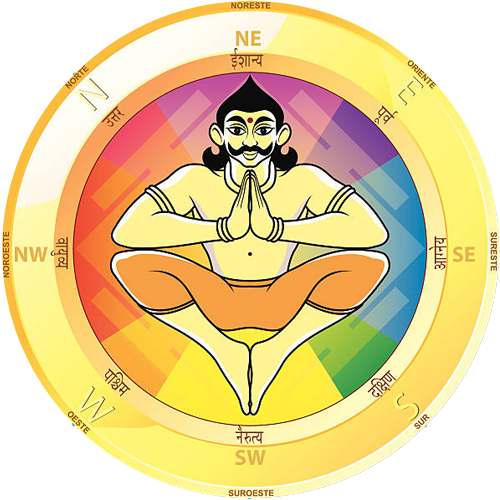
Energy spent while working, sleeping, meditating, or performing daily activities is deeply influenced by vastu direction. According to Vastu Shastra, every vastu disha carries a specific type of energy that can either support success, health, and harmony or create imbalance in life.
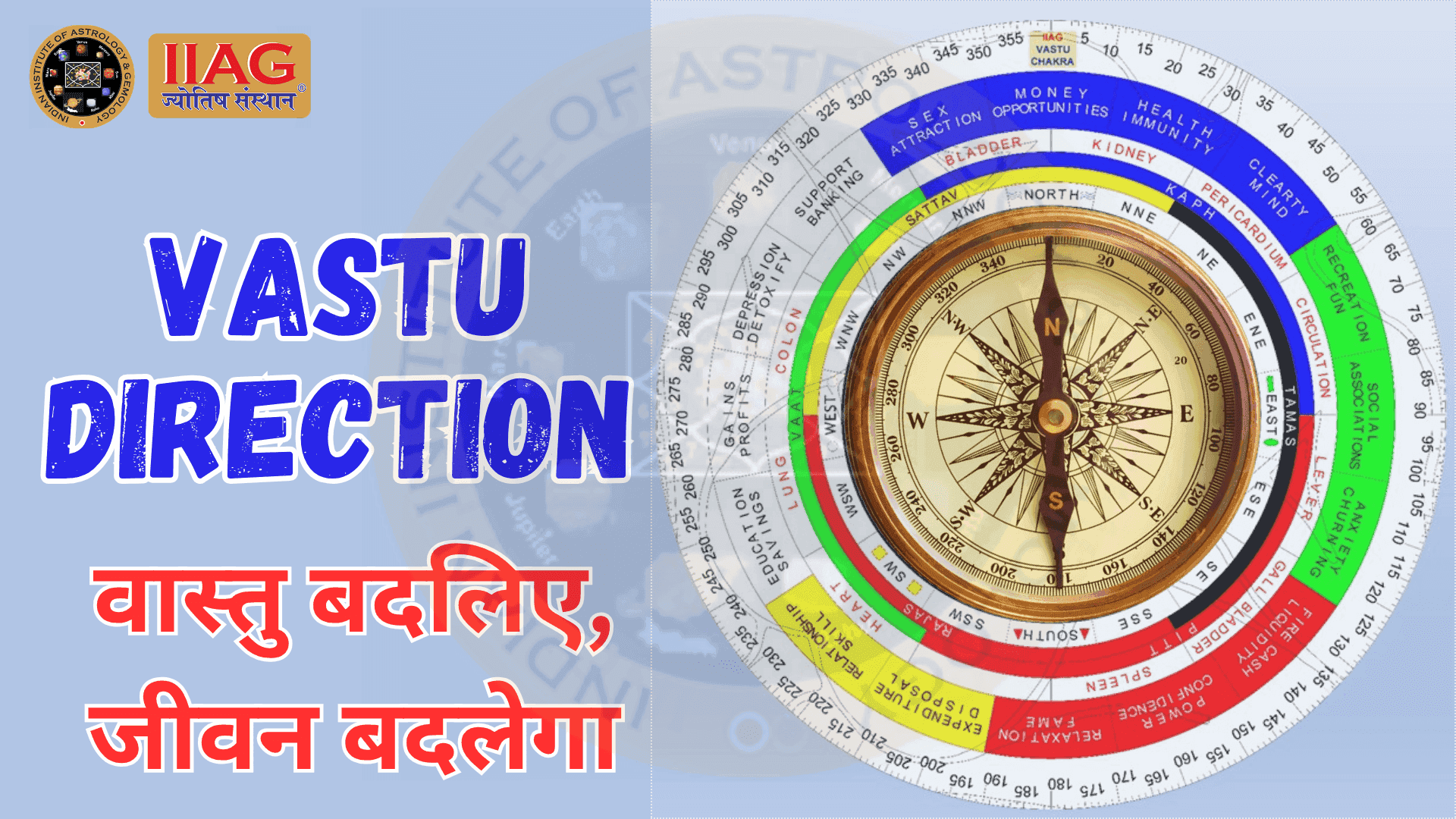
Understanding the vastu direction chart helps in aligning your home, office, and personal spaces with natural cosmic forces. Whether you are choosing the right sleeping direction or setting up your workstation, correct alignment with the 16 directions in Vastu can significantly improve positivity and mental clarity.
In Vastu Shastra, directions are not just geographical divisions. Each direction represents a unique energy zone. These are divided into:
These four are the base of every vastu direction chart.
Each auxiliary direction is further divided into two equal halves. This division creates the concept of vastu 16 directions, also known as 16 vastu zones.
For example:
This precise division forms the complete 16 directions of Vastu system.
There are a total of 16 directions in Vastu, including 8 cardinal and 8 ordinal divisions.
|
Direction |
Degree |
|
North |
0° / 360° |
|
Northern Northeast (NNE) |
22.5° |
|
Northeast (NE) |
45° |
|
Eastern Northeast (ENE) |
67.5° |
|
East |
90° |
|
Eastern Southeast (ESE) |
112.5° |
|
Southeast (SE) |
135° |
|
Southern Southeast (SSE) |
157.5° |
|
South |
180° |
|
Southern Southwest (SSW) |
202.5° |
|
Southwest (SW) |
225° |
|
Western Southwest (WSW) |
247.5° |
|
West |
270° |
|
Western Northwest (WNW) |
292.5° |
|
Northwest (NW) |
315° |
|
Northern Northwest (NNW) |
337.5° |
This structured system forms the complete vastu direction chart used for house planning and energy balancing.
An interesting observation in the vastu disha chart is that when the digits of each degree are added, the total equals 9.
Examples:
Because of this pattern, many people consider the number 9 powerful and auspicious. It is often preferred in vehicle numbers and business registrations due to this belief.
The central point of any plot or house is known as Brahmasthan. It is the geometric center from where all 16 vastu zones are determined.
To mark directions correctly:
The remaining four triangular spaces automatically form:
Thus, the entire vastu 16 directions system is mapped accurately.
Many believe each direction occupies exactly 45°. However:
Both methods are acceptable under practical application of the vastu direction chart.
The Earth’s molten iron core causes magnetic deviation, making Magnetic North different from True North.
For practical Vastu application:
Hence, for everyday use and home planning, marking magnetic north is sufficient.
For apartments and flats, along with the 8 main directions, two additional vertical dimensions are considered:
Placement of water tanks, staircases, pumps, servant quarters, and terrace structures affects the entire building. Therefore, all 16 directions of Vastu must be considered carefully.
Proper alignment ensures:
Vastu Shastra is not merely about architectural planning; it is about planning energies. Correct understanding of vastu direction, vastu disha chart, and 16 directions in Vastu ensures harmony between the individual and the universe.
Each direction holds importance for different aspects of life. When the vastu 16 directions are followed correctly during construction or interior planning, they open doors to prosperity, stability, and positive energy.
Awareness of direction is the first step toward living a Vastu-compliant life. Align your space with the correct vastu direction chart, and allow natural energies to work in your favor.
 Vedic Astrology
 KP Astrology
 Advance KP
 Vastu Shastra
 Astro-Vastu
 Energy Healing
 Astro Advice
 Vastu Guidance
 NG Software
 NJ Patrika
 Gemstone Selection
 Rudraksh Selection

 Vedic Astrology
 KP Astrology
 Advance KP
 Vastu Shastra
 Astro-Vastu
 Energy Healing
 Astro Advice
 Vastu Guidance
 NG Software
 NJ Patrika
 Gemstone Selection
 Rudraksh Selection
